Moving to Japan: What You Actually Need to Relocate (A Practical Guide)

Moving to Japan is exciting.
The process is not.
You hear words like “visa,” “COE,” “residence card,” “My Number,” “ward office,” and “status of residence” before you know what they mean.
You wonder what you need to prepare before leaving your country, what your company handles, and what you need to do after arriving in Japan.
This guide is for you.
It focuses on the practical process: what you need, when you need it, and what happens after you land.
First, Understand the Basic Flow
If you are moving to Japan for a full-time engineering role, the process usually looks like this:
You receive and accept a job offer from a company in Japan.
Your employer helps apply for your Certificate of Eligibility, often called a COE.
You use the COE to apply for your visa at a Japanese embassy or consulate in your country.
You enter Japan during the valid entry period on your visa.
You receive your residence card when you arrive, or after registering your address.
You register your address at your local city or ward office.
You set up the basics of daily life: phone, bank account, salary payment, housing, utilities, and transportation.
The important thing to understand is that your visa is what allows you to enter Japan. Your residence card and status of residence are what allow you to live and work in Japan after you arrive.
Step 1: Get a Job Offer From a Company in Japan
Before you can move to Japan for work, you generally need a sponsoring employer.
For most engineers, the relevant work status is usually Engineer/Specialist in Humanities/International Services. This category is commonly used for software engineers, infrastructure engineers, cloud engineers, data engineers, technical consultants, product specialists, and other professional roles that require technical or specialist knowledge.
To qualify, you usually need to show that your background matches the role. In practice, this often means one of the following:
A university degree related to the work you will do
A relevant diploma, certificate, or academic background
Relevant professional experience, often around 10 years if you do not have a degree
A job offer from a company in Japan
Your employer’s situation also matters. Immigration looks at both the candidate and the sponsoring company. A well-prepared company or HR team can make the process much smoother.
Step 2: Prepare Documents for the Certificate of Eligibility
Before you apply for your visa, your employer in Japan usually applies for your Certificate of Eligibility, or COE.
The COE is not the visa itself. It is a document issued in Japan that confirms you appear eligible for a certain status of residence. Once the COE is issued, you use it to apply for your visa at the Japanese embassy or consulate responsible for your country or region.
In many cases, your company, HR team, or immigration specialist prepares most of the application. However, you still need to provide personal documents.
What you usually need to prepare
Valid passport
Passport-style photo
Resume or employment history
University diploma, degree certificate, transcript, or other proof of education
Proof of relevant work experience, if you are applying based on experience instead of education
Signed offer letter or employment agreement
Personal information requested by HR or the immigration specialist
Expected arrival date in Japan, if requested
First accommodation address in Japan, if requested
What your employer usually prepares
COE application forms
Company information
Job description
Salary and employment details
Company registration, financial, or business documents
Inviter, sponsor, or guarantor information, if required
The COE stage is usually the longest part of the immigration process. Your coworker, HR team, or immigration specialist may not receive detailed updates while the application is being reviewed, so there is often a period where the only option is to wait.
A realistic timeline is often around 1 to 3 months, although this can vary depending on the company, immigration office, application details, and time of year.
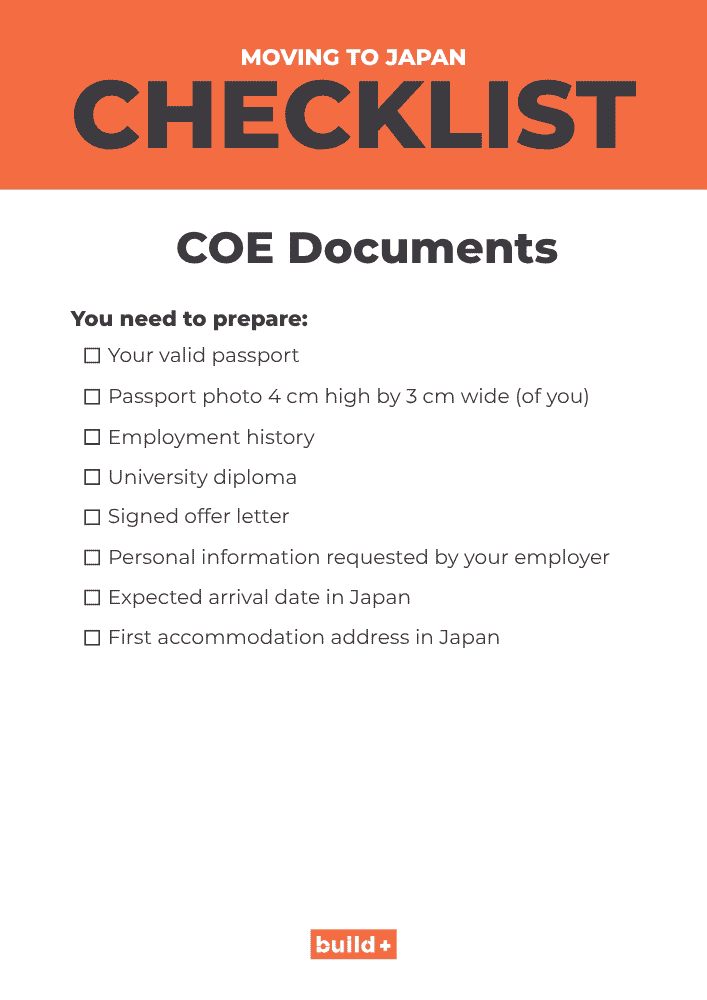
COE CHECKLIST
(click to download)
Here is a checklist of the things you need to prepare to receive your Certificate of Eligibility:
Step 3: Apply for Your Visa From Outside Japan
Once your COE is issued, the next step is your visa application.
This part is usually your responsibility. You apply through the Japanese embassy or consulate that handles visa applications for your country or region. Depending on the location, you may be able to apply in person or by mail.
What you usually need for the visa application
Valid passport
Completed visa application form
Passport-style visa photo
Certificate of Eligibility, or printed copy of your electronic COE
Any additional documents requested by the embassy or consulate
Return envelope or mailing documents, if applying by mail
If you apply in person and there are no issues, this stage may be relatively quick. If you apply by mail, you should allow extra time for shipping and processing.
Once approved, your visa is placed in your passport. Check the entry window carefully. Your visa allows you to enter Japan during a certain period. It does not mean you can enter whenever you want in the future.
After you arrive in Japan, your residence card becomes the key document for daily life.
Step 4: Prepare Before You Fly
Once your visa is issued, you can prepare for your move.
At this stage, the goal is not to solve every part of life in Japan before you arrive. It is to make sure you can enter Japan, stay somewhere, access money, and complete the required procedures after landing.
What you need before flying
Passport with your issued Japanese visa
Flight booking
First accommodation address in Japan
Contact details for your employer, HR team, or relocation contact
Access to money before your first salary payment
Credit card, debit card, or cash that works in Japan
Copies of your employment contract, COE, visa documents, and housing details
Temporary housing is usually enough at first
Many people moving from overseas cannot secure a long-term apartment before arriving. That is normal.
You may start with:
Hotel
Serviced apartment
Share house
Monthly apartment
Company-arranged temporary housing
Short-term rental
This first address is important because you may need it for immigration, arrival forms, HR paperwork, and later address registration. It does not have to be your permanent home.
Resources
We are not affiliated with this service, but they reached out to us:
https://smilehome.tokyo/
Here is a service that I worked with when finding my apartment:
Tsubasa from this company speaks english and was very helpful.
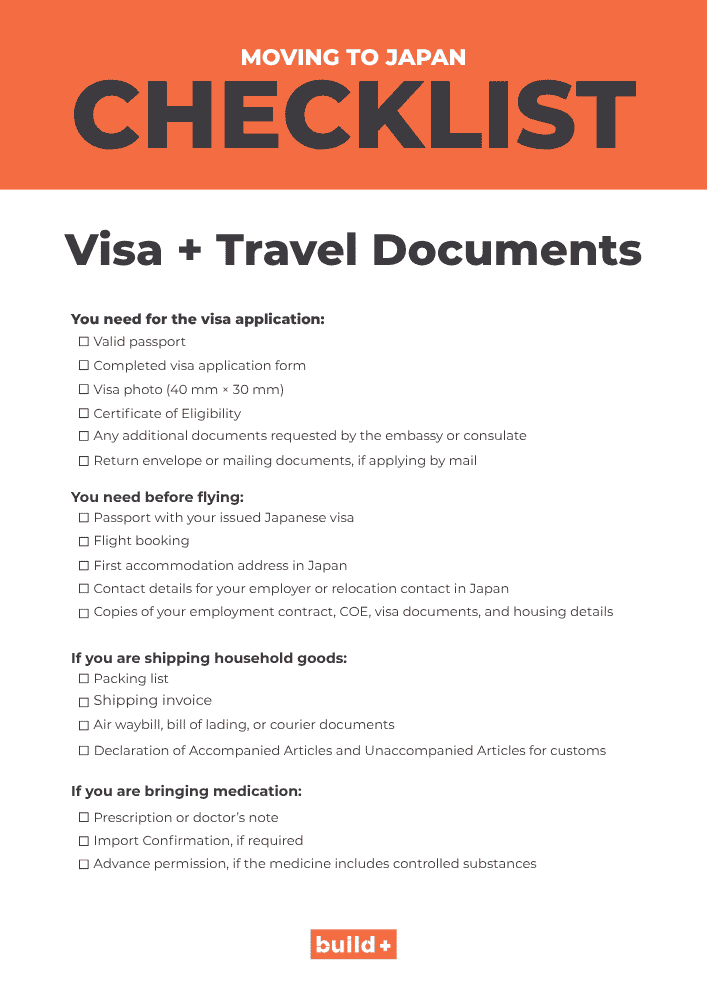
Visa and Travel Documents Checklist
(click to download)
Here is a checklist for what you need to get your visa and travel to Japan:
Step 5: Enter Japan and Receive Your Residence Card
When you arrive in Japan as a medium- to long-term resident, you receive a residence card.
At major airports, your residence card may be issued when you arrive. If your arrival airport does not issue residence cards, your passport will show that the card will be issued later. After you register your address, the residence card is usually mailed to your registered address.
What you need when entering Japan
Passport with your issued visa
Certificate of Eligibility, if requested
Arrival information
Customs declaration
First accommodation address in Japan
What you receive at the airport
Residence card, or
Passport stamp showing your residence card will be issued later
The residence card is one of the most important documents you will use in Japan. You will need it for address registration, banking, phone contracts, housing, payroll, and other procedures.
If You Do Not Receive Your Residence Card at the Airport
If you enter Japan through one of the major airports, your residence card is usually issued when you arrive. These airports include Narita, Haneda, Chubu, Kansai, New Chitose, Hiroshima, and Fukuoka.
If you enter Japan through another airport or port, your residence card may not be issued at the airport. In that case, your passport will show that your residence card will be issued later.
What you need to do
Enter Japan with your passport and issued visa.
Confirm that your passport shows your residence card will be issued later.
Move into your first address in Japan.
Go to the city or ward office for the area where you live.
Submit your moving-in notification, called 転入届(tennyū todoke).
Bring your passport instead of your residence card.
Bring your Japanese address.
Bring family relationship documents and Japanese translations if you are registering family members and the office requests them.
Complete your resident registration.
Wait for your residence card to be mailed to your registered address.
Until your residence card arrives
Until you receive your residence card, you should carry your passport as your main ID. After your card arrives, you will use it for address registration confirmation, phone contracts, banking, housing, payroll, and other daily-life procedures.
If the residence card does not arrive
If your residence card does not arrive after you register your address, contact the city or ward office first to confirm that your moving-in notification was completed correctly and that your registered address is correct.
If the municipality confirms your registration is complete but the card still does not arrive, contact the Immigration Services Agency or your nearest Regional Immigration Services Bureau for next steps.
This is different from losing a residence card after it has already been issued. If your residence card is lost or stolen after you receive it, you need to apply for reissuance at a Regional Immigration Services Bureau.
Step 6: Register Your Address at the City or Ward Office
After you arrive and move into your first address, you need to register your address at your local city or ward office.
This is usually done by submitting a moving-in notification, called 転入届(tennyū todoke).
You generally need to complete this within 14 days after deciding where you will live.
What you need for address registration
Residence card, if issued at the airport
Passport
Japanese address
Moving-in notification form from the city or ward office
My Number Card, if you already have one
Family relationship documents, if registering family members and requested by the office
What happens after registration
Your address is added to your residence card.
You are registered as a resident of that city or ward.
Your My Number information is issued or mailed later.
You can move forward with more daily-life setup, such as banking and phone contracts.
Do not write your address on the residence card yourself. The city or ward office handles the address registration.
Step 7: Set Up the Basics of Daily Life
After your address is registered, you can complete the basic setup needed to live and work in Japan.
What you need to set up
Japanese phone number
Japanese bank account
Bank account details submitted to your employer
Rent payment method
Electricity contract, if not included in your housing
Gas contract, if not included in your housing
Water contract, if not included in your housing
Home internet contract, if needed
Mobile Suica or Mobile PASMO on your phone, if your device supports it
Physical Suica or PASMO, if mobile setup is not available
Commuter pass, if required for company commuting reimbursement
Local garbage sorting and collection information
A Japanese phone number and bank account can be especially important. Many services in Japan require a domestic phone number, and your employer will usually need a Japanese bank account to pay your salary.
Some banks may be easier than others for new arrivals. Requirements can vary depending on the bank, your residence status, your address, and how long you have been in Japan. Your employer may recommend a bank that is easier for new employees to use.
Housing in Japan
Housing is one of the biggest practical challenges when moving from overseas.
Japanese apartments are often smaller than what you may be used to, and many come unfurnished. You may need to buy appliances, curtains, lighting, furniture, and other basics after moving in.
Common layout terms include:
1R: One-room studio
1K: One room with a separate kitchen area
1DK: One room plus dining-kitchen space
1LDK: One bedroom plus living-dining-kitchen space
2LDK: Two bedrooms plus living-dining-kitchen space
When signing a long-term rental contract, you may need:
Residence card
Japanese phone number
Japanese bank account
Emergency contact
Guarantor company
Initial payment
Initial housing costs can include:
First month’s rent
Deposit
Key money
Agency fee
Guarantor fee
Fire insurance
Cleaning fee
Lock exchange fee
Because this can be difficult to arrange from overseas, many people first stay in temporary housing and search for a long-term apartment after arriving.
Opening a Bank Account
Opening a bank account in Japan can be more complicated for new arrivals than many people expect.
You will usually need:
Residence card with registered address
Passport
Japanese phone number
Proof of employment, depending on the bank
Personal seal, depending on the bank
My Number information, depending on the service
Some banks may have restrictions for people who have been in Japan for less than six months, although requirements differ by bank. Your employer may recommend a bank that is easier for new employees to use.
Common banking terms include:
銀行 (ginkō): Bank
口座 (kōza): Bank account
通帳 (tsūchō): Bankbook
振込 (furikomi): Bank transfer
引き出し (hikidashi): Withdrawal
入金 (nyūkin): Deposit
残高 (zandaka): Balance
Popular options include major banks, Japan Post Bank, online banks, and banks with English-friendly services. The best choice depends on your employer’s payroll requirements and your need for English support, online banking, international transfers, or credit card access.
Bringing Medication to Japan
If you are bringing medication, check the rules before departure.
Some medication that is common overseas may be restricted or controlled in Japan. Depending on the type and amount, you may need an Import Confirmation before you travel.
You may need:
Prescription or doctor’s note
Import Confirmation, if required
Advance permission for certain controlled substances
Do not assume that medicine allowed in your country is automatically allowed in Japan.
Moving With Family
If your spouse or children are moving with you, you may need dependent visa documents.
Common documents may include:
Passport for each family member
Dependent visa application documents
Marriage certificate for a spouse
Birth certificate for children
Passport-style photos
Certificate of Eligibility or dependent visa documents, if required
You may also need family relationship documents when registering everyone at the city or ward office in Japan. If the documents are not in Japanese, the municipality may request Japanese translations.
If you are moving with children, you should also research school and childcare options early. Availability, language, cost, and location can vary significantly.
Moving With Pets
If you are bringing a dog or cat to Japan, start early. The process can take months because Japan has strict animal quarantine rules.
For dogs and cats from non-designated regions, the process generally involves:
Microchip
Rabies vaccinations
Rabies antibody test
Waiting period
Advance notification before arrival
Export certificate
Import inspection in Japan
If all requirements are met, quarantine on arrival can be short. If documents are missing or timing is wrong, quarantine can be much longer.
Do not leave this until the last minute. Pet relocation is one of the areas where early planning matters most.
Shipping Household Goods
If you are shipping household goods to Japan, check customs requirements carefully. Unaccompanied baggage and household goods generally need to be declared properly and cleared within the required timeframe after your arrival.
You should prepare:
Packing list
Customs declaration
Passport copy
Residence card copy, if required
Shipping documents
Proof that goods are personal effects, not commercial goods
Japan apartments can be compact, so think carefully before shipping large furniture. In many cases, it may be easier and cheaper to bring essentials and buy furniture locally.
Transportation
Japan’s public transportation is one of the easiest parts of daily life. Trains, subways, and buses are reliable, clean, and extensive, especially in Tokyo, Osaka, Nagoya, Fukuoka, and other major cities.
Many companies cover commuting costs, although policies vary. If you commute regularly, you may use a commuter pass. You can also use IC cards such as Suica or PASMO for daily travel.
When choosing housing, do not only look at distance on a map. Look at:
Train line
Transfer count
Walking distance to the station
Rush hour crowding
Last train time
Access to office
Access to airport
Access to schools or childcare, if relevant
A place that looks close geographically may be inconvenient if the train connection is poor.
Set Up Mobile Suica or PASMO
You will need a way to pay for trains, buses, and local transportation soon after arriving in Japan. In the past, most people bought a physical Suica or PASMO card at a station. Today, it is often better to set up Suica or PASMO on your phone if your device supports it.
Iphone
You can usually add Suica or PASMO directly to Apple Wallet.
You need:
Compatible iPhone or Apple Watch
Apple Account with two-factor authentication
Payment card added to Apple Wallet
Suica or PASMO added as a transit card
Enough balance charged to the card
Express Mode turned on for easy gate entry
To set it up:
Open Apple Wallet.
Tap the add button.
Select Transit Card.
Choose Suica or PASMO.
Add money.
Follow the on-screen instructions.
Set it as your Express Transit Card.
Once it is set up, you can tap your phone or Apple Watch at ticket gates, buses, convenience stores, vending machines, and other places that accept IC payments.
Android
Mobile Suica and Mobile PASMO may not work on every Android phone. Your phone usually needs to support Japanese mobile payment technology such as Osaifu-Keitai / FeliCa.
You need:
Compatible Android device
Mobile Suica or Mobile PASMO app, depending on the card you use
Payment method for charging the balance
Suica or PASMO set up for transit use
If your overseas Android phone does not support mobile Suica or PASMO, you may need to use a physical IC card, paper tickets, or another compatible device.
If your company reimburses commuting
You may need to confirm your commuting route before buying a commuter pass. Depending on your route, Suica or PASMO may be more convenient. Your company may also ask for your route and commuter pass cost for reimbursement.
Phone, Internet, and Daily Setup
You will likely need a Japanese phone number soon after arrival because it is often required for banking, housing, delivery, and online registration.
You can choose from major carriers, budget carriers, SIM-only plans, and eSIM options. Home internet may take time to install, especially in older buildings, so confirm what is available before signing a lease.
Many engineers prefer to set up:
Japanese mobile number
Home fiber internet
Mobile Suica or PASMO
Delivery apps
Banking app
Translation app
Map and train apps
City garbage-sorting app or local ward guide
Learning Japanese
Japanese is one of the best long-term investments you can make after moving to Japan.
For engineers, the goal does not need to be perfect fluency immediately. Start with practical Japanese that helps you communicate at work and manage daily life.
Useful learning options include:
Online Courses
Online courses are useful if you need structure. Popular choices include JapanesePod101, Nihongo-Pro, iTalki lessons, and structured self-study programs.
Apps
Apps are useful for daily practice. Duolingo can help with basic consistency, while Anki is excellent for spaced repetition. For kanji and vocabulary, tools like WaniKani, Bunpro, Renshuu, and Yomichan-style reading tools can be useful depending on your learning style.
Textbooks
Good beginner-to-intermediate textbooks include Genki, Minna no Nihongo, and Japanese for Busy People. If you are serious about business communication, move toward business Japanese materials after you have a solid foundation.
Language Exchange
Language exchange is useful once you can hold basic conversations. Tandem, HelloTalk, Meetup groups, and local conversation events can help you practice real communication.
Workplace Practice
If your company has Japanese-speaking colleagues, ask for safe, low-pressure opportunities to practice. Even small improvements can make your life much easier.
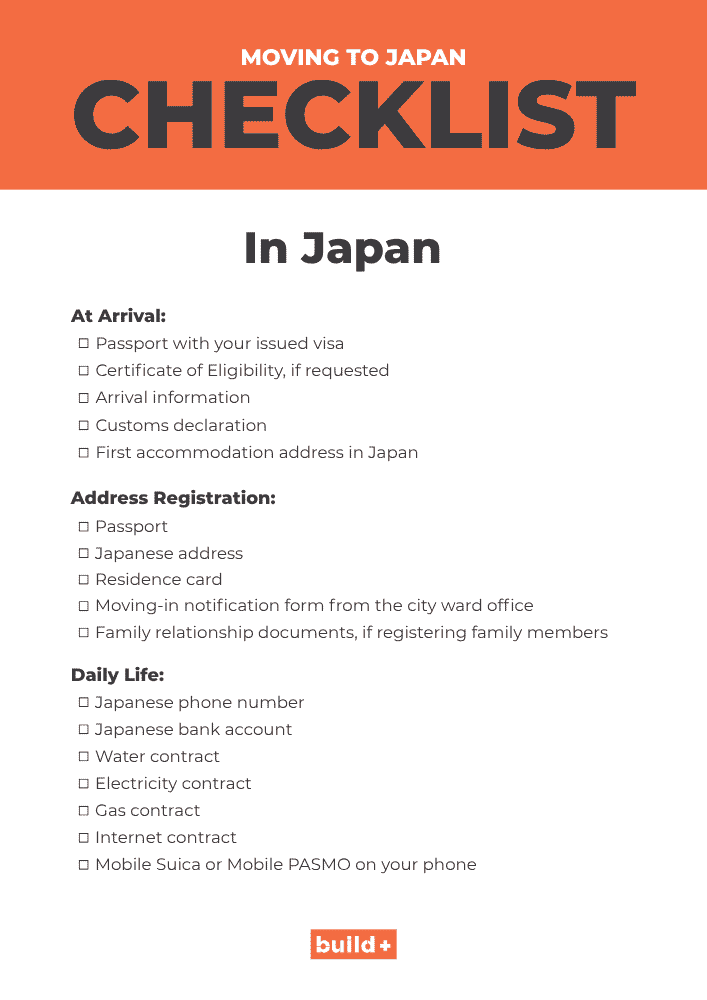
Questions to Ask Before You Move
Before relocating, ask yourself:
Are you moving alone or with family?
Does your spouse or partner also need a visa?
Are you bringing children?
Do you need school or childcare support?
Are you bringing pets?
Are you shipping household goods?
Do you need temporary housing?
How much cash do you need for move-in costs?
Will your company support city registration and banking?
What happens if the visa timeline is delayed?
What Japanese level will you need in the role?
Is the role fully English-speaking, bilingual, or Japanese-first?
Is remote or hybrid work allowed?
What is included in the relocation package?
What is your expected take-home pay after deductions?
The more clearly you answer these before accepting an offer, the smoother your move will be.
FAQ: Moving to Japan
Do I need a job offer before I can move to Japan for work?
In most cases, yes. If you are moving to Japan for a full-time engineering job, you usually need a job offer from a company in Japan. That company will normally act as your sponsor for the Certificate of Eligibility and work visa process.
What is a Certificate of Eligibility?
A Certificate of Eligibility, often called a COE, is a document issued in Japan before your visa application. It shows that you appear to meet the requirements for a specific status of residence.
Your employer, HR team, or immigration specialist usually applies for the COE in Japan. After it is issued, you use it to apply for your visa at a Japanese embassy or consulate outside Japan.
Is the COE the same as the visa?
No. The COE and visa are different.
The COE supports your visa application. The visa is placed in your passport and allows you to enter Japan during a specific entry period. After you arrive, your residence card becomes your main document for living and working in Japan.
Who applies for the COE?
Usually, your employer or an immigration specialist applies for the COE in Japan. You normally provide your personal documents, such as your passport copy, photo, resume or employment history, and proof of education or work experience.
The company usually prepares the company-side documents, such as job details, salary information, company information, and sponsor details.
How long does the COE process take?
The COE process is usually the longest part of the relocation process. A common timeline is around 1 to 3 months, but it can vary depending on the company, immigration office, document quality, and application details.
What do I need for the visa application after I receive the COE?
You usually need your passport, visa application form, passport-style photo, and COE or printed electronic COE. Depending on your nationality and the embassy or consulate, you may be asked for additional documents.
Do I apply for the visa in Japan or in my home country?
If you are currently outside Japan, you normally apply at the Japanese embassy or consulate responsible for your country or region. Depending on the consulate, you may be able to apply in person or by mail.
How long does the visa application take after the COE is issued?
If there are no issues, the visa application can be much faster than the COE process. Some consulates process visas in around five working days, but mail-in applications, local consulate rules, missing documents, or additional checks can make it take longer.
Can I book my flight before the visa is issued?
You can research flights, but it is safer to book after your visa is issued. You should also check the entry period on your visa, because the visa allows you to enter Japan only during a specific window.
Do I need a permanent apartment before arriving in Japan?
No. Many people moving from overseas start with temporary housing, such as a hotel, serviced apartment, share house, monthly apartment, or company-arranged housing.
You usually just need a first address in Japan where you will stay after arrival. After you are in Japan, you can search for long-term housing.
Will I receive my residence card at the airport?
If you arrive at a major airport that issues residence cards, you may receive it when you enter Japan. These airports include Narita, Haneda, Chubu, Kansai, New Chitose, Hiroshima, and Fukuoka.
If you arrive through another airport or port, your residence card may not be issued at arrival. In that case, your passport should show that the card will be issued later.
What happens if I do not receive my residence card at the airport?
If you do not receive your residence card at the airport, you usually register your address first at your local city or ward office. After your address registration is complete, your residence card is normally mailed to your registered address.
This applies to people newly entering Japan from overseas. If you are already living in Japan and renewing, changing, or replacing your residence card, you usually handle that through the Regional Immigration Services Office.
When do I need to register my address?
After you arrive and decide where you will live, you generally need to register your address at your local city or ward office within 14 days.
This is done by submitting a moving-in notification, called 転入届(tennyū todoke).
What do I need to register my address?
You usually need your residence card, passport, Japanese address, and the moving-in notification form from the city or ward office.
If your residence card was not issued at the airport, you can usually register using your passport. If you are registering family members, the office may ask for documents proving your family relationship, such as a marriage certificate or birth certificate.
What is My Number?
My Number is Japan’s individual identification number used for tax, social security, and government procedures. After you register your address, your My Number information is usually issued or mailed to you.
Your employer may ask for your My Number for payroll, tax, and social insurance procedures.
Do I need a Japanese phone number?
Yes, you will likely need a Japanese phone number soon after arrival. A phone number is often needed for banking, housing, delivery services, online accounts, and company procedures.
Do I need a Japanese bank account?
Yes. Your employer will usually need a Japanese bank account to pay your salary. Requirements vary by bank, and some banks are easier for new arrivals than others. Your employer may recommend a bank that works well for newly relocated employees.
Can I set up Suica or PASMO on my phone instead of buying a physical IC card?
Yes, if your phone supports it. For many new arrivals, Mobile Suica or Mobile PASMO can be more convenient than looking for a physical card.
If you use an iPhone or Apple Watch, you can usually add Suica or PASMO through Apple Wallet. If you use Android, compatibility depends on whether your device supports the required Japanese mobile payment technology.
If mobile setup does not work, you may need a physical Suica, PASMO, Welcome Suica, paper tickets, or another local transit option.
Do I need Japanese to work as an engineer in Japan?
Not always. Some engineering teams operate mostly in English, especially at international companies, startups, and globally minded tech companies.
However, Japanese ability makes daily life much easier. It also helps with housing, banking, city office procedures, healthcare, and long-term career growth.
Can I bring my spouse or children?
Yes, but they will need the correct dependent visa documents. You may need passports, dependent visa applications, marriage certificates, birth certificates, photos, and other documents depending on your situation.
If you are moving with family, confirm early whether your employer or immigration specialist will support dependent applications.
Can I bring my pet to Japan?
Yes, but you need to prepare early. Japan has strict animal import rules for dogs and cats. You may need microchip documentation, rabies vaccination certificates, rabies antibody test results, advance notification, and an export certificate from the government authority in your departure country.
Can I bring prescription medication to Japan?
Usually yes, but it depends on the medicine and amount. Some medications require Import Confirmation before you travel, and some controlled substances require separate permission.
You should check your medication before departure, especially if you take stimulants, psychiatric medication, pain medication, or a larger supply.
Should I ship furniture and household goods to Japan?
Only if it makes sense for your housing and budget. Japanese apartments can be smaller than what you may be used to, and many people buy furniture after arrival.
If you ship household goods separately, you need customs documents such as a packing list, shipping documents, and the Declaration of Accompanied Articles and Unaccompanied Articles.