How to Actually Build Your Brand From Zero in Japan (What ACTUALLY Worked)

This blog was written by Japan 5x Founder Tyson Batino. Learn more about Tyson here: TysonBatino.com
Starting a brand from scratch in Japan is rarely about “having the perfect idea.”
It is about earning trust fast, picking the right channels for the right stage, and building a system that turns early attention into repeatable growth.
I have scaled several Japan focused businesses.
I chose one or two main channels based on intent and one or two based on awareness and then double down on what works better. The combination of the two worked well for me as in some cases, awareness worked better than focusing on intent.
Pick channels by intent, not by hype
When you are unknown, you cannot “scale” anything yet. Your first job is to match your marketing to what the customer is doing in their head.
I use three buckets:
Capture demand. Search, Maps, high intent ads. People are already looking, your job is to show up and convert.
Create demand. Social, PR, community, content, outbound. People are not searching yet, your job is to earn attention and make the problem feel real or communicate how we are different or the timing is right now where it was not before.
Convert and leverage. Email, follow up systems, proof. Your job is to turn interest into customers, and customers into advocates.
Most new brands fail because they jump to “create demand” tactics before they have the conversion and proof layers to capitalize on it. In Japan especially, trust is not nice to have. It is the product.
Below are four launch stories, each showing how a brand went from unknown to growing by deliberately choosing intent matched channels.
One Coin English. Use distribution to buy your first proof
For a brand new consumer business, the hardest part is getting the first real volume. Not vanity metrics. Real customers walking in the door.
What worked first was Groupon as a distribution hack. The goal was not a margin. The goal was initial volume that could be turned into reviews, testimonials, and operational learning.
Then we layered trust. PR and TV coverage acted like a credibility shortcut, and it improved conversion.
Once trust was in place, Google Search and Maps became the long term engine. That is to capture demand at its best.
The early mistake was simple and common. We assumed the low price would attract customers by itself. It did not, at least not initially. People do not buy cheap unless it is GroupOn. They buy safe and that was why we needed social proof like TV coverage.
The fix became a repeatable playbook:
Build an onboarding system that converts promo buyers into long term students
Stack credibility layers. Reviews, testimonials, third party validation from TV, social proof at every touchpoint
Use email for reactivation. Follow up with inquiries and no shows, recover revenue that most businesses quietly lose
Japan Switch. Let constraints define the brand, then win on demand creation
Sometimes you start with constraints that feel like weaknesses. Japan Switch had plenty:
Morning only, weekday only operations
Beginner to low intermediate only
No business Japanese, no test prep
No Google Ads. Meta and organic had to work
Instead of fighting those, we treated them as positioning. A narrow promise is easier to understand, easier to share, and easier to deliver consistently.
With limited capture demand options, the launch leaned heavily into demand creation. Meme led creative and seasonal themes drove shares. We used “comment trigger” style creative to boost reach, not as a gimmick, but as a distribution mechanic inside the algorithm.
The key was the bridge plan. Run paid long enough to build compounding assets like SEO, an email list, and word of mouth momentum.
This is how you turn a demand creation channel into a long term brand builder, instead of a forever expense.
Scaling Your Company. Start with conversations, then earn authority
For a brand new B2B service, the “from zero” problem looks different. You do not need millions of impressions. You need a small number of people to believe you can deliver. That was my challenge with Scaling Your Company which helps Japanese and foreign clients with revenue growth (marketing and sales) advisory and digital marketing services for the Japan market.
The early phase was sales led:
Peer groups helped land the first paying clients as they could see the value of the advisory service I provided.
Based on those conversations, we did outbound sales target those who have the exact pain point as those who switched from free to paid client.
Podcast / Media brought very high quality leads who have already spent hours engaging with our content and were easy to close.
A podcast can be tiny and still be powerful if the audience is high intent. It helped close larger contracts because it compresses trust and they were serious about doing research into the Japan Market. SEO and blog content then created steady inbound for smaller clients and referral revenue.
The core lesson is worth stating plainly. For services, proof plus authority beats volume.
SmartStart Japan. Build trust carefully in high intent, high sensitivity markets
Starting from zero in legal adjacent, high intent services comes with a different set of rules. You cannot optimize for attention if it risks accuracy or compliance - ex. A company promoting that they know unique and novel methods. That was the challenge with Smart Start Japan, which helps foreign businesses set up in the Japan market.
The channel mix reflected that:
Establish baseline inbound by using Google Ads to capture high intent users.
Use LinkedIn for referrals - to reach those who are not searching on google and are asking their networks for trusted vendors.
Expand to SEO and YouTube to reach a broade audience.
This is an important reminder for anyone launching in regulated or trust heavy categories. You are not just building awareness. You are building a reputation and your competitors are always looking at you.
A simple launch checklist for building a brand from zero in Japan
If you want something practical to apply this week, start here:
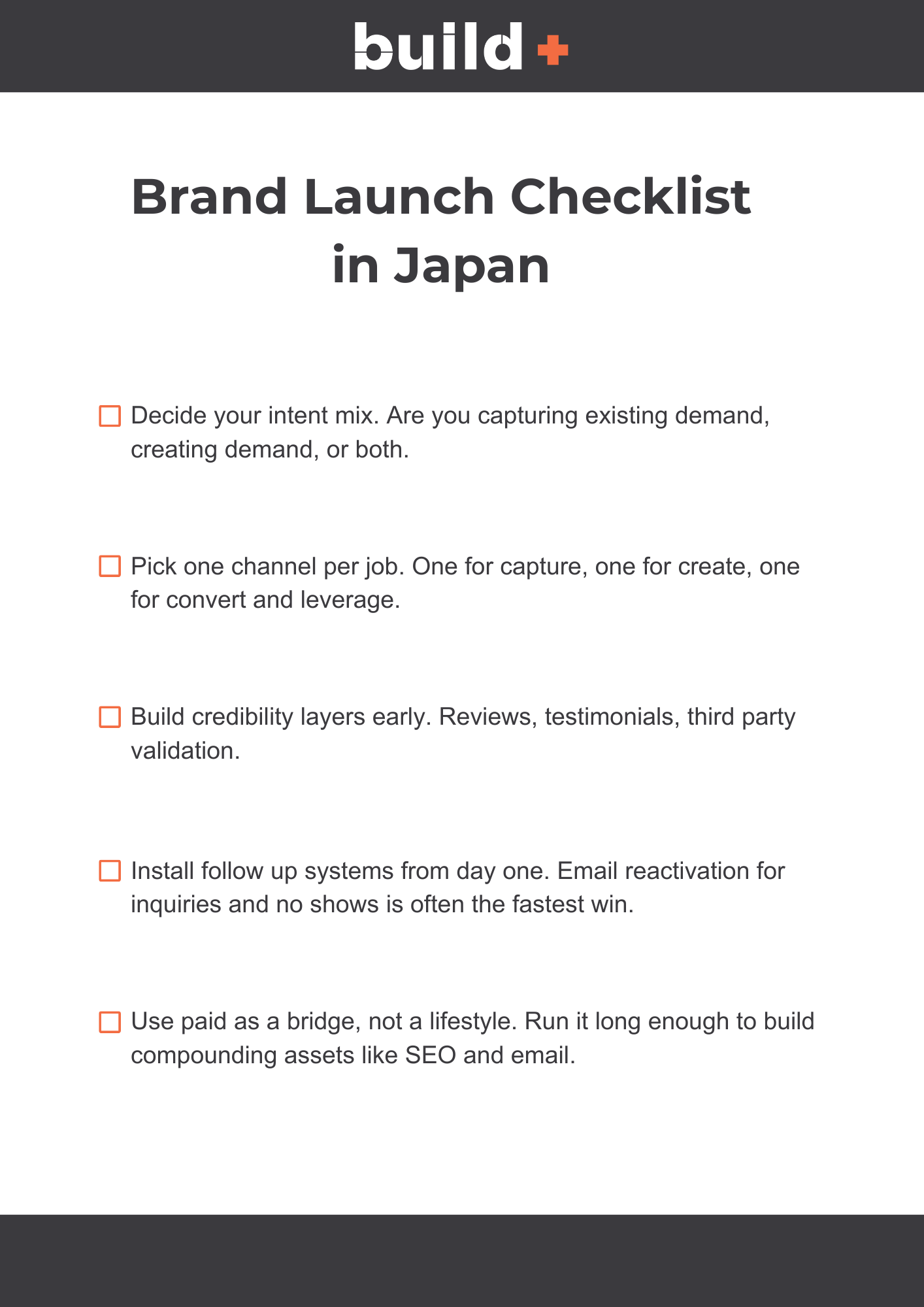
Decide your intent mix. Are you capturing existing demand, creating demand, or both.
Pick one channel per job. One for capture, one for create, one for convert and leverage.
Build credibility layers early. Reviews, testimonials, third party validation.
Install follow up systems from day one. Email reactivation for inquiries and no shows is often the fastest win.
Use paid as a bridge, not a lifestyle. Run it long enough to build compounding assets like SEO and email.
I am using this same playbook to scale AI Market, a company I co-founded and launched in October 2025. We sell foreign software to the Japanese Market offering a lifetime deal one time purchase. We help vendors localize the software and we sell it through our Marketplace. We are focusing on mainly the Japanese speaking population for scalability reasons, but starting with the English community to get some quick wins and cash flow.
Here is a downloadable version (it is not clickable):
If you are ready to launch your business in Japan, Tyson will be a great help. Reach out to him at TysonBatino.com
If you are ready to build your team in Japan, message us using this link.